
On Saturday 22 November, we gathered at the Dunningham Suite, Dunedin City Library, to celebrate the double book launch of Ruth Dallas: A writer’s life by Diana Morrow and This Moment, Every Moment: Ruth Dallas Collected Poems edited by Nicola Cummins. It was a beautiful event and we thank everyone who came to help us celebrate.
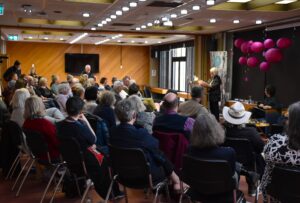
Professor Emerita Jocelyn Harris launching the two books.
We held a special author talk between Diana Morrow and Nicola Cummins, in conversation with OUP publisher, Sue Wootton. We were also delighted with a musical performance of Ruth’s poems by Cathy Highton-Sim (soprano) and Anthony Ritchie (pianist). Afterwards, we had a lovely afternoon tea provided by the wonderful team at the City of Literature Dunedin, Nicky Page and Anne Shelah. Thank you to everyone who made this event happen. Thank you also to Jill Bowie from the Dunedin City Library for the photography, videos and the amazing backdrop. And thank you to the University Book Shop Otago for being our awesome booksellers on the day.
A massive thank you also to the wonderful Jocelyn Harris, who launched the two books for us and gave a moving speech to open the event. Here’s her speech:
In one of his many admiring responses to the poems of Ruth Dallas, Charles Brasch speaks of his shock and delight at reading them: ‘they really are movingly lovely, and only a great poet could have written them’. So why isn’t she better known? Well, when Dallas began to publish in the forties, condescension and plain old snobbery were rife in New Zealand. Diana Morrow’s compelling biography, Ruth Dallas: A Writer’s Life, reveals how at that time, men looked down on women, urban on rural, north on south, profession on occupation, and poets on the predecessors they contemptuously labelled Georgian. No wonder that Dallas was under-estimated when she was a woman from rural Southland, she worked as a secretary, and she developed her own poetic styles and subjects. And yet she survived and flourished in that hostile environment.
Morrow pays tribute to her resilience, courage and belief in her own worth. The biography is a detailed and readable record of her life, her work, her reviews, her relationships with Brasch and others, and her writing for children. In Morrow’s account, the woman regarded as reticent and modest was alert and acerbic: she called a writers’ conference in Christchurch ‘a kind of cat fair … much backscratching and a great deal of hissing behind whiskers’.
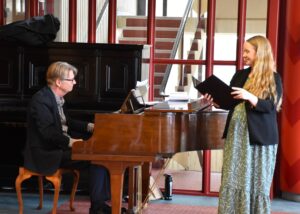
Cathy Highton-Sim (soprano) and Anthony Ritchie (pianist) performing three Ruth Dallas poems.
It was all too easy to underestimate the unobtrusive but watchful Ruth Dallas. She dressed plainly, and after her fiancé went to the war and found someone else, she stayed put with her mother Minnie Mumford then her niece Joan Dutton. Commenting on the attention paid to writers who had travelled, she remarked, ‘What about writers who have never moved off their home plot, like Jane Austen and Thomas Hardy?’
While some of her male contemporaries were busily constructing their identities in relation to New Zealand, Dallas had something larger in view. As Morrow reports, she followed her own advice to ‘Read and read. Read widely’. The spare, compressed words of ancient Chinese and Japanese poets led her to embrace forms of brevity and density such as the haiku. They loved words, she said, ‘and they painted them with a brush, lovingly’. Like them, she writes about beauty, joy, suffering, cycles of death and renewal, the defeat of death by art, and the art of concealing art:
Years may pass before a poem wears a slant hat
the easy appearance
of being slapped together
casually in a spare moment
when the poet had nothing better to do.
Morrow traces the unlikely alliance between Dallas and Brasch with tact and insight––Dallas the self-educated, self-supporting woman from a southern province and Brasch the independently wealthy, well-educated and widely-travelled man. Nevertheless, they worked closely together on Landfall and profitably critiqued each other’s writing. Morrow shows how she supported him as much as he supported her––more personal assistant than secretary, she kept the house at Broad Bay stocked with bread and milk. She was also essentially his deputy-editor, dealing with correspondence and triaging manuscripts for him to review. And yet Brasch chose Robin Dudding to succeed him as editor of Landfall, probably because of Dudding’s national contacts. The outcome for Dallas was that on her seventy-second birthday, she lost her occupation and her income. But the friendship endured. She nursed Brasch in his last days, and published the moving and magnificent Last Letter to Charles after his death.
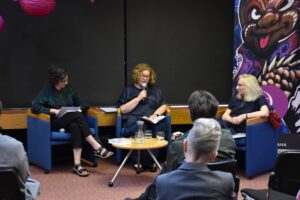
Left to right: Sue Wootton (publisher), Nicola Cummins and Diana Morrow.
Thanks to Morrow’s extensive research, many of you will find your appreciation for Ruth Dallas acknowledged and recorded. Morrow quietly names and shames the few critics who unwittingly repeated centuries of derogatory comments about women writers––even a professed admirer opined that her poems were ‘pure silver, if there is no gold in it neither is there any any dross’. Silver, minor, small, slight, feminine, female, woman. Dallas fought for the publication of her poems and stories, she earned some necessary income from School Publications, she wrote books for children, and she collaborated with artists, composers, academics, and other writers.
The Burns Fellowship, the honorary doctorate, and the CBE all came in the end. I suspect that Alan Horsman and Margaret Dalziel had great deal to do with those honours.
Nicola Cummins pays Dallas a further tribute in her definitive and scholarly edition, This Moment, Every Moment: Ruth Dallas Collected Poems. The generous layout, the invaluable Index of titles and first lines, and the strong binding, sturdy enough to withstand a multitude of readings and re-readings, make it a joy to own and to handle. In a succinct, perceptive Introduction, the product of many meticulous hours spent combing through the poet’s note-books and correspondence as well as those of other people, Cummins shows how even the first poems published n the children’s pages of the Southland Times under the unfortunate title of ‘Little Pakehas’ shed light on what would be perennial concerns in her work: nature, animals and a keen observation of mutability. As Cummins nicely calls it, ‘her typical looking out rather than looking in’. She reveals that the prophetic twelve-year-old chose the perfect pseudonym for herself, ‘Multum-in-parvo’, or ‘infinite riches in a little room’. Dallas had lost an eye when young, and Nicola speaks of writing all the poignant for its fragility, a ‘potential sensory deprivation, where the gifts of reading and writing were never guaranteed’. Children especially love the visual, sensual ‘Milking before Dawn’, which has been reprinted, anthologised and read in classrooms all over the country. For me at least, the choice for the cover of Kashana Bush’s striking ‘Woman among potted plants’ signifies the ability to thrive even in the most constrained circumstances. A good editor is a taonga, and readers of Ruth Dallas will be grateful to Nicola for generations to come.
I’d also like to play tribute to Nicola’s remarkable support for writers more generally, through the City of Literature, the Robert Lord Cottage, the Burns Fellowship, the Dunedin Writers and Readers festival, theAthenaeum, and more.
Between them, Diana Morrows and Nicola Cummins have restored the mana of a great poet. You are all in for a treat.
Jocelyn Harris
Professor Emerita