

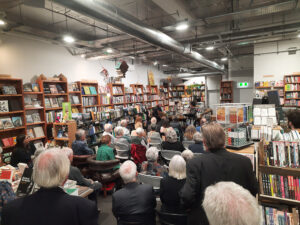
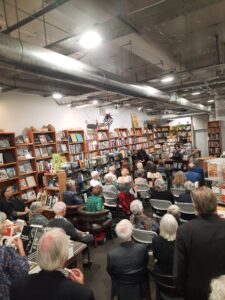
On Wednesday March 11, we came together to celebrate the release of A Day Like No Other: Selected poems by James Norcliffe. Hosted by the wonderful Scorpio Books in Christchurch, we had a great crowd to celebrate the incredible work of James Norcliffe captured in this new collection. Erik Kennedy was kind enough to launch the book, and gave a fantastic launch speech.
You Should Tell a Cheetah That It’s Fast
Nau mai, haere mai. Kia ora kotou katoa. Ko Erik Kennedy ahau. I’m Erik Kennedy: a poet, critic, editor, and performer. Welcome to the launch of A Day Like No Other: Selected Poems, by James Norcliffe, published by Otago University Press.
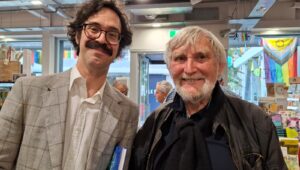
Erik Kennedy and James Norcliffe
I think when you launch a single collection by a poet, the launch speech should wrestle earnestly with the style, the subject matter, the intellectual context, the arguments, the circumstances of the book’s composition. It should be public-facing criticism. (At least that’s how I approach such launches.) But I think when you launch something like a selected poems, you need to pause for a moment and just bask in the writer’s achievement. It is an achievement! Because let’s face it, very few people who ever write poems find themselves in the position of a having a career-encompassing document like A Day Like No Other—and almost everyone has written a poem. Most of the kids you were at school with who wrote poems about their cats or houses don’t wind up with a selected, for example. But they probably didn’t have the insights into cats and houses that James has.
Let’s consider cats. In ‘The true story of soap’, he invents a new theory of hygiene that derives from observations of felines:
humans and cats
are each
fastidious creaturesbut as we cannot
easily reach
our backsidessoap is a convenient
extension of the tongue
Let’s consider houses. In ‘Indwell this house with joy’, James captures that eerie sense you sometimes get that homes are full of a miasma of their occupants’ feelings, as if the ‘joy’ of the poem’s title is actually something rather menacing:
it is something far
too easy to imagineamong the skeletal framing
of dwangs and naked joists
a pendular shadow dark
and slow-moving across
the grey concrete and up
the walls and back again
 This is not the kind of work that just anyone could write. So that’s a slightly unfair comparison with every Tom, Dick, and Harry who’s ever written a poem; I grant that. But the thing is, most poets who publish books don’t come anywhere near a selected, either. In fact, I believe I once read that the most common non-zero number of books a poet will have in their career is one. I know that sounds like the kind of made-up stat that I love, but it is a figure that indirectly tells two truths.
First, you have to have things to say! For years and years. All of James’s literary street cred and contacts and mana wouldn’t count for much if he up and stopped writing poetry one day. If there weren’t new poems coming, there wouldn’t be new books, and we wouldn’t be here tonight looking at this beautiful object. On average, throughout a four-decade career, a new James Norcliffe volume has come along with greater frequency than the World Cup (which I also look forward to) and American elections (which I don’t look forward to). And bear in mind that all this poetry has been produced alongside an impressive body of fiction, both for adults and younger readers. A lot of poets of my acquaintance these days are turning to novels at the expense of poetry (I name no names!); James has had the thorough decency throughout his career to never do this. A lesson, I say, for the poets who think they’ve ‘moved on’ from poetry.
And the second truth is this: it’s fine and dandy to have things to say, but you have to say them well. In my short foreword to this book I drop some not-so-subtle hints that I think James’s work is getting better and better (‘I believe he keeps getting better and better’—see, I said it wasn’t subtle). Again, this is a key part of why there is demand for a Norcliffe selected. Because his poems are relevant, psychologically compelling, quietly and loudly political, concerned with history and our place on the planet and in the cosmos. A Day Like No Other brings into focus just how frequently he shoots for and hits the difficult, high-value targets. ‘A poem is the very image of life expressed in its eternal truth,’ according to Shelley. I am usually inclined to give Shelley the benefit of the doubt, and I am inclined to say that James has always discerned the importance of the eternal.
 Why am I labouring over what may seem like obvious points? Because I worry slightly that we take James Norcliffe for granted. Because he gets on with his task. He builds up others. He enables. He has what I might describe as a bred-into-the-bone West Coast modesty. He doesn’t trumpet his successes; it’s hard to imagine him even puckering his lips near a boasting-trumpet. In ‘The death of Seneca’ James writes: ‘Such a gesture of indifference is the shrug— / indifference with a hint of disdain’. I think there might be in James a certain shruggy indifference not to literature (no, no, no), but to some of the trappings of official literary culture. And then we buy into it, too, and we tell ourselves that things like milestones don’t matter that much.
Well, not tonight! Not on my watch. Tonight, we do celebrate a milestone. You should tell a cheetah that it’s fast, tell a bird of paradise flower that it’s colourful, tell a diamond that it is very hard, and you should tell a poet like James Norcliffe that his work is penetrating and memorable, beautiful and alarming. I trust you will all say such things to James in the signing queue.
It is noteworthy that the publication of A Day Like No Other was timed to coincide with a significant round-number birthday for James. There are perhaps a few more poems about ageing and mortality in the recent collections. In my foreword I write that James understands that ‘death is a package holiday we all have booked for us’. But I think my favourite James Norcliffe ageing poem might be a slightly earlier one, from Along Blueskin Road, in 2005.
Lone pine at Quarantine Point
this headland
has been given to meI have given the storm
my voice my needles
and crouched before itthe sea glitters before me
the hills rise about methe whaleboats were beached
in the little bay belowthe shrouded bundles
were shouldered up the cliff
and given to the clayit has been easy
I have grown old
knotted and gnarledI have few gifts to give
sighs and needles
and when the sun goes down
shadow for these scattered
mounds
There’s ageing in here, but also agelessness, stubbornness, endurance—and the decision to use one’s endurance (whether you’re a pine tree or an artist) to give comfort to the fallen. It’s gorgeous, isn’t it? This is a long-winded way of saying that this launch is also kind of eightieth birthday party for a poet who is here for us to offer ‘shadow for these scattered / mounds’.
As American heartbreak pop singer Lesley Gore, who was born in the same year as James Norcliffe, 1946, sang: ‘It’s my party, and I’ll cry if I want to’. This is James’s party. And I think we all hope if there are any tears tonight, they will be tears of joy. Please join me in wishing joy to this wonderful pukapuka and its author, James Norcliffe.