
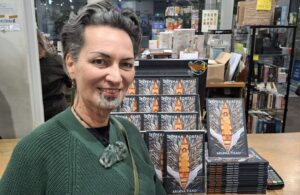
On Thursday 16th of April, we launched the debut collection, Pepeha Portal by Ariana Tikao, at the wonderful Scorpio Books. There were amazing speeches and readings from Ross Calman, Tama-te-ra Tikao Calman, Matahana Tikao Calman (who provided a speech and poem that was read by Ross Calman), Ciaran Fox publisher Sue Wootton, and Ariana Tikao herself.
The book was launched for us by Dr Kelly Tikao, who gave this incredible speech on the night:
I started writing this wee launch kōrero before I received the digital version of Ariana’s new pukapuka, and when I read it, it reiterated how in sync we are. The theme I wanted to reiterate in my kōrero was a theme also echoed in many of Ariana’s poems. ‘Bones’ and ‘Wombs’ with an “b”, not worms but wombs.
I love both the sound and width of emotion these two words offer. Bones of our whakapapa and of ourselves, buried in urupā, bones of the whenua, good bones, the backbone of a kaupapa. Bones. In Ariana’s poem, Te Taniwha she wrote, “I died and became a taniwha, bones stretching into fishy flesh” and in her poem, South/Te Toka, “The urupā of Rāpaki still holds my bones, the shape of it an open throat, chanting”.
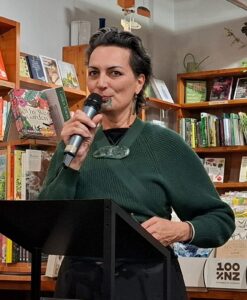 And I am deeply intrigued with wombs – for those who know me you will understand why mana whānau, mana wāhine, mana kōpū means so much to me. So, I was delighted to see that womb references and acknowledgements were also beautifully highlighted in this pukapuka hou.
Of a womb, from a womb, in a womb – this uniting phenomenon that all of us standing and sitting in this room, and indeed the world share. We come from a womb, that came from another womb and birthed from another. We have womb whakapapa or womb journeys, from the void, te kore, from the darkness, te pō, the womb of Papatūānuku – the earth womb, the womb of Hinemoana or the womb of the ocean, the womb of Hineahuone – our first wāhine made by Tane but guided by Papatūānuku, and the many womb that held space, and those that birthed – our whare tāngata.
The use of the word pepeha in the book title is a tool, the hinu, the conduit that brings the external to the internal and vice-versa. Like a mother to child through the umbilical cord or iho. The cord of connection between us and between our land, sea and sky.
Our human creation cycle is a mere mimic of earths creation and like Ariana’s poems they address birth with realism yet capture the wonder and profoundness of creation. In her poem, Surfacing/Diving she says, “Sweet hot pain, fire breathing her, into Te Ao Marama, her womb-wet body out, in the atmosphere”.
Ariana’s first whare, the kōpū she was sheltered in was a popular place, well -used, well-loved and like a morning bed, temperature and comfort, perfect. This kōpū that housed Ariana was created by an extraordinary woman.
Lois Alison Pearce – Ariana’s mother.
“Eat your crusts and your hair will curl” said the domestic queen of golden syrup pudding and the best banana cake ever, who had mastered the art of wearing hair rollers, vacuuming the house, attending to seven kids and animals in need of her attention and feeding. While the aroma of baking wafted throughout the whare, and getting herself ready for her years of work in various supermarkets and cleaning at the airport. Lois truly deserved her honours in her Bachelor of ‘Wifery’.
Part Italian – exotic looking, legs eleven, Lois was one of five girls, who adored ballet.
“Pull that face and if the wind changes you will stay like that!” was another ‘Loisism’. A mantra she would impart as she dished out meat and three vege and more golden syrup pudding! It must have been a mantra from this era because I heard these too alongside, “eat your carrots and you will be able to see in the dark” and “if you swallow chewing gum it will stay in your stomach for seven years”. Which relates to Ariana’s poem titled, From, “I’m from picking, the hardened chewing gum off footpaths, spitting out grit like pips, coaxing back the flavour with persuasive saliva and metal-filled teeth”
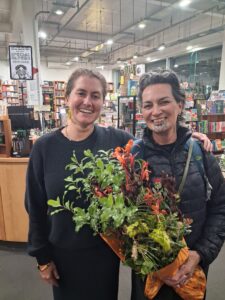 Now, I’m from this too and I didn’t realise this was so unusual until I told people about what I would do…I also peeled chewing gum from under tables and chairs. Both Ariana and I are still alive and that old chewing gum has had years to make its way out of our bodies! So, I figure we’re going to be ok.
Lois was raised alongside her sisters in South Brighton, Christchurch, so close to where I live now. She met George Tikao (Ariana’s pāpā) whilst working at the Heritage Hotel in Hamner and they were married at the same time they were pregnant with their first born Greg, and then the rest of the tamariki followed: Marie, Graig, Debbie, David, Nathan and Ariana, or Leanne as she was given at birth without a middle name simply Leanne Tikao. Ariana reclaimed her Māori identity as stated in her piece titled, The Tikao Name, she adorned herself with both a Māori first and middle name, Ariana Rahera. And, not only that Ariana became stauncher as she aged. While recording with cousins Holly and Solly they nicknamed themselves with gangsta names and Ariana became Ariansta and in badass fashion at the height of her reclamation Ross and Ariansta would secretly laugh when people would ask her if she knew a Leanne Tikao and they would think, “That bitch is dead” (a line from her poem, The Tikao Name) this really spoke to my humour and the strength of liberation.
Lois’s Bachelor of ‘Wifery’ came from her own place of knowing and lived experience. Lois believed for her older girls that this is how they should be too. Get married, have children and complete your own Bachelor or ‘Wifery’. Until Ariana turned up and refused to go to this University of thinking that did not meet her creative brief. Ariana was a young proud and inquisitive Māori woman, who gleaned the knowledge from all those wombs before her. She sung the sounds that inspired her, she came under the spell of Hineraukatauri and mastered the art of writing, and continues to pen her thoughts, her cultural vista into poetry and stories. Always inspired by her movement through life and her womb knowledge that housed her own two beautiful tamariki, Matahana and Tama Te Rā, with her incredibly talented husband, Ross.
Ariana’s world became her words, thoughts and sounds and this book brings some of that to the fore, however, there are many more pukapuka to fill, to muse over and create your own images of the scenes shared in Pepeha Portal all perceived from our own womb perspective.
And Ariana taught Lois to accept her values, her expression of self, and in doing so, it allowed Ariana to fly in her creative career with her mother quietly fan girling her all the way.
I wanted to bring Lois into this book launch because Lois was, according to Ariana’s siblings, Ariana’s biggest supporter. Every time Ariana had a performance on, all her siblings were informed by Lois that they must go, must, and watch her show. When Lois passed at the age of 79 years, 10 years ago, I was recovering from an operation in Dunedin hospital so did not make it to her funeral. So, I wanted to honour Lois and represent her at another exceptional Ariana occasion.
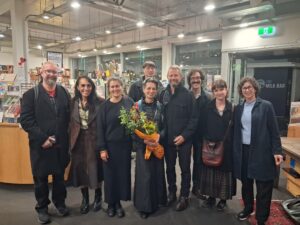 Lois left perhaps some untold stories, and some that her tamariki share about this: loyal, traditional woman, family loving and binding person, who heard more than we perhaps realised, similar to my mother, that represented a group of women, that we, as the next generation, perhaps struggled to see them as being free but more as kept. And why is it you get things later on – the epiphany of understanding, the context you weren’t privy too when you were a child staying at your best cousin’s whare over the holidays and witnessing other mothering or as a teenager and young adult wearing the patch of feminism so boldly until you discovered yourself, as a mother, as a partner, a wife. Until you were humbled by your womb knowledge forgotten in new learnings and adventures away from home.
And, if it wasn’t for Lois bringing Ariana into this world, Ariana wouldn’t be here, her pepeha would not exist and this book we see before us today would not be real. But it is. And Ariana is, and so to my sista-cuz, I am always in awe of you, and I am glad Lois birthed you into this world. So, we can grow old bones together and transition to ruahine now that our wombs carry the stories of our whakapapa from whence, we came and what life we brought forward.
No reira koutou mā, naumai tauti mai anō ki te whakarewatanga o tēnei pukapuka hou ko Pepeha Portal.