
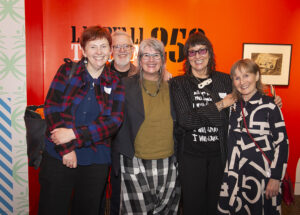
Jill Bowie, Steve Gallagher, Sarah Gallagher, Lynn Vare and Nicky Page
On Thursday 16 October, we celebrated the launch of Landfall Tauraka 250 and the opening of the accompanying exhibition in Special Collections.
We’re grateful to Head Curator Kirstie Ross and Liaison Curator Alexander Ritchie, for their superb work on the exhibition. Sincere thanks also to Vice-Chancellor Grant Robertson for launching the book and officially opening the exhibition, and to University Librarian Mike Wall for his excellent MC duties.
Our appreciation also goes to the University Book Shop Otago for bookselling, Murray Eskdale for beautifully capturing the evening in photos, and Daniel Alexander for his inspired exhibition design.
Finally, thank you to everyone who joined us – especially those who travelled to be there. It was a wonderful evening and a fitting celebration of this special milestone.
Here are some words from Landfall Tauraka editor Lynley Edmeades:
The 250th issue of Landfall Tauraka marks an extraordinary milestone – not just for the journal itself, but for the wider literary and artistic community of Aotearoa. Across its 250 issues, writers and artists have continually explored what it means to live here, on this land, in this moment in time.
This is a complex and confusing time to be alive, a sentiment that I suspect has been expressed by many editors and the writers they gather since the birth of the literary journal or anthology. In other words, we are always in a state of becoming, of figuring out, wrestling with the here and now; our current state of existence is, at best, precarious; at worst, completely futile. And literature – and the many voices represented here – can help us wrestle with and navigate that. As Brasch himself said in the very first issue of Landfall, ‘The arts do not exist in a void. They are products of the individual imagination and at the same time social phenomena; raised above the heat and dust of everyday life, and yet closely implicated in it.’
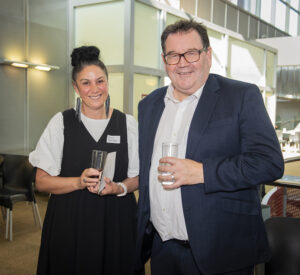
Donna Waitere and Vice-Chancellor Grant Robertson
Like every issue of Landfall, there are some incredible names in this one – there are some familiar names of Aotearoa letters, the greats like Ian Wedde, Cilla McQueen, Elizabeth Smither, Robert Sullivan, Kirsty Gunn, Owen Marshall. They’re in great company: I’ve put them in kōrero with many others, new writers like Tōrea Scott-Fyfe, Josiah Morgan, Kim Cope Tait, Ada Duffy, some of our flourishing mid-career writers, like Louise Wallace, Chris Tse, Hinemoana Baker, and in the company of previous editors of the journal – poets Chris Price, Emma Neale and David Eggleton. There are incredible artists – Kai Tahu artist Simon Kaan, Christchurch-based Pacifica artist John Vea, and of course, the incredible Fiona Pardington, whose work is featured inside and whose piece, My Tūī Sings, adorns the cover and has become the icon for this new chapter of Landfall Tauraka’s history.
The issue also announces the winner of the 2025 Kathleen Grattan Poetry Award, Lynn Jenner, and the winner of the 2025 Landfall Tauraka Essay Prize, Tasmin Pritchard. There are essays by Paula Morris, John Prins and Ash Davida Jane about what Landfall means to them, as three different generations of Aotearoa writers. And the issue also ushers in the launch of a new series, the Landfall Tauraka Craft Interview. The inaugural interview was done with Bill Manhire.
These writers in these pages can, if we let them, show us not only what it means to live in Aotearoa in 2025, but how to live in it; how to make sense of things in such a way that we can make meaning, tell our stories, tell ourselves stories (in order to live). What this curation represents, I hope, is a place where we can all find some refuge in knowing that we’re not out to get each other, as our political climate would have us believe – that this space, as Brasch conceived it, is for us all. We – readers and writers – can all exist and thrive here; we can lay all our complexities and contradictions out to bare. Because – at the risk of sounding terribly sentimental – our messiness is what makes us human. And our particular brand of human is of the whenua that holds and sustains us, the place from which we go on. It is no surprise that so many of the voices in this issue speak back to precisely that, the land and our place in it. As the current editor, I believe I am performing not the role of gatekeeper or even custodian, but something more akin to the midwife: an entry point for the ushering in of all our many voices. As the new bilingual name represents, Landfall Tauraka is a landing place, a safe harbour.
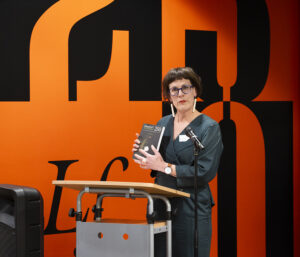
Lynley Edmeades
In 2025, at 250 issues, the document you have in your hands is, to my mind, an extraordinary insight into the health and vitality of Aotearoa arts and letters. It is, I hope, a version of the beautiful whakataukī about birdsong in the forest: E koekoe te tūī, e ketekete te kākā, e kūkū te kererū; the tūī chatters, the kākā gabbles, the kererū coos. This metaphor for polyphony is woven into our land – appreciating the many voices creates a rich and harmonious chorus for the future. The more we can listen to the many sounds of our people, the stronger our tolerance for and promotion of our diversity will be. With a nod to our past, a gesture to our contemporary moment, and with an eye to our future, it is the concept of he huihuinga reo, the ensemble, that captures the current direction for Landfall Tauraka. I am proud and honoured to stand behind this kaupapa, and I believe Brasch would be, too.
Find out more about Landfall Tauraka 250 here
Subscribe to the journal here